The book I didn't expect to write...
Chapter 1: The Wobble

A lot of people have encouraged me to write a book over the years (thank you!). In 2024/5, as my time as a consultant was drawing to a close, I finally did.
I now work full time for a former client 😊 I started in February 2025, which is why things have been quiet on the newsletter front. That’s about to change.
Over Christmas, I 99% finished the manuscript and drafted a cover. As part of the final polish before publishing, I’m going to share it here one chapter at a time, and I’d love your feedback.
It probably won’t be what you’re expecting… But I hope it sparks something! If it does (or doesn’t) let me know. 🙏
Here goes:
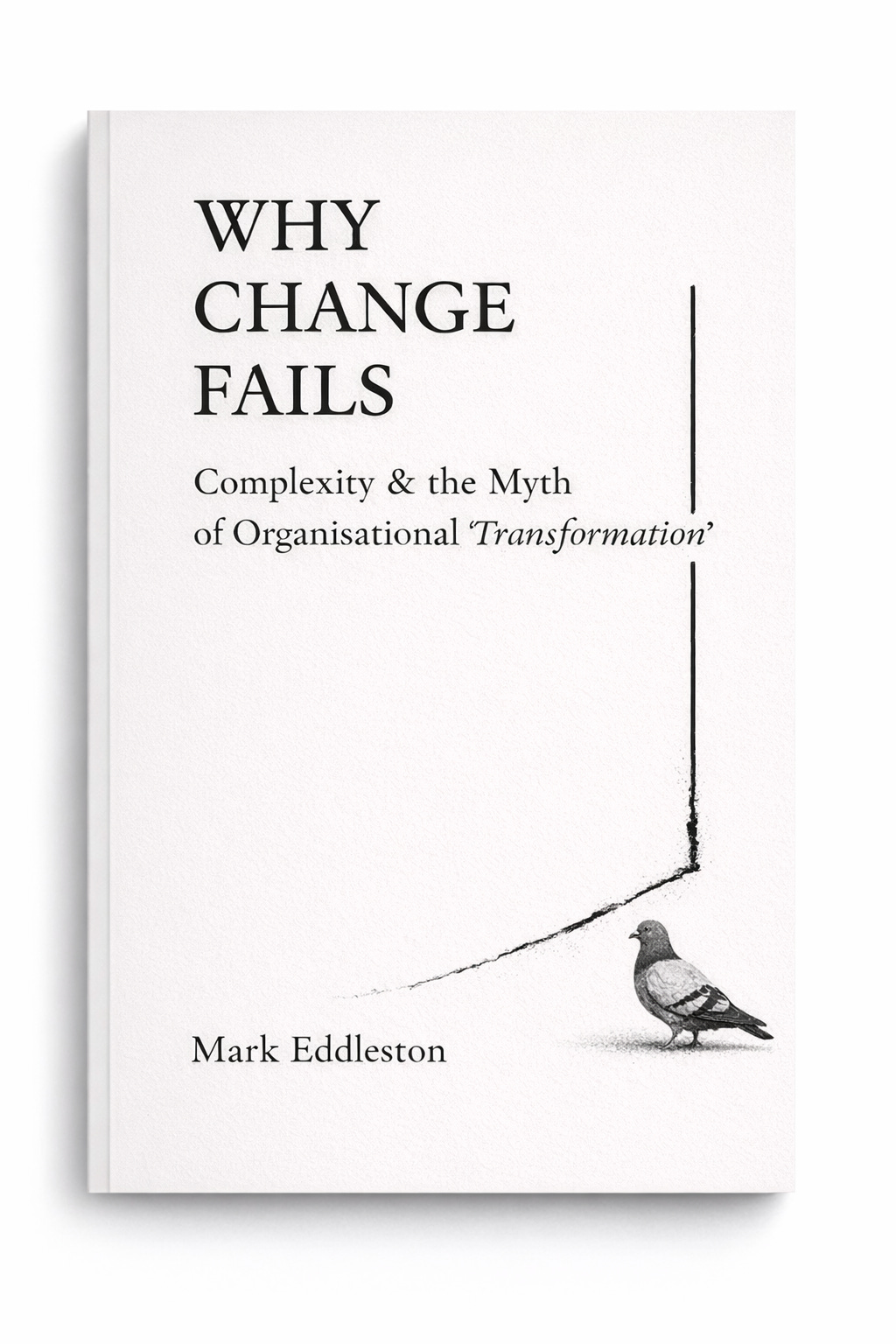
Part I: The Confession
Chapter 1: The Wobble
The first time I suspected I was full of sh!t, I was standing in a kitchen in Bristol watching someone make tea.
It was 2021. I remember because we were back to in-person sessions after the pandemic interruption, and there was still that slight awkwardness of being in rooms with people again. I’d been working with this team for months. Good people. Engaged, curious, willing to try things. We’d done the whole toolkit: check-ins, circle meetings, the advice process, feedback profiles, working agreements etc etc. They’d run experiments. They’d reflected. By any measure I was using at the time, it was working. And then I overheard two of them talking while the kettle boiled.
— “How long do you reckon we keep doing the rounds thing?”
— “Until Mark stops coming, probably.”
They laughed. Not cruelly. Fondly, even. The way you laugh about a visiting relative’s quirks. Oh, that’s just what we do when he’s here. I didn’t say anything. I finished my tea, wrapped up the session, sent the follow-up email, and of course the invoice. But something had cracked. A hairline fracture I’d spend the next few years trying to ignore, then trying to understand, and finally, reluctantly, trying to write about. The thing about being a consultant is that you get very good at pattern recognition. You see what’s working. You notice resistance. You develop antennae for the room. What I’d failed to develop, apparently, was antennae for what happened when I left it.
I’d built my entire practice on the premise that if you keep an eye on mindset, give people the right tools and enough practice, New Ways of Working would stick. The metaphor I used constantly, embarrassingly in retrospect, was training wheels. Circle meetings were training wheels for consent decision-making. Check-ins were training wheels for psychological safety. Run enough experiments, and eventually the team would pedal off on their own. The kitchen conversation suggested a different, equally crap metaphor. Maybe I wasn’t providing training wheels. Maybe I was the wheels. And when I left, they just... stopped cycling.
Some time later, I’d find a line from complexity theory that named what I was sensing: the conditions for a complex system to thrive have to emerge from within. They can’t be installed from outside, no matter how good the installation team. Development is what you do, not what others do for you. But I didn’t have that language yet. All I had was the uncomfortable suspicion that my presence was doing the heavy lifting, and my absence was doing the revealing.
This should have prompted immediate soul-searching. It didn’t. I had a course to run, newsletters to write, a reputation as someone who helped teams work better. And here’s the uncomfortable bit I need to name early: the arrangement was working fine for me. The teams might revert after I left, but by then I’d been paid. The experiments might fade, but the invoices had cleared. Our obsession with prepackaged methodologies might not help organisations much, but it is a godsend for consultants. I was building a livelihood on something I was starting to suspect didn’t work. The machinery of being a New Ways of Working person doesn’t leave much room for wondering if the whole thing is a bit pointless. So I filed it away. An anomaly. This team, this context, something specific to their situation. Not a pattern. Patterns, of course, don’t care whether you’re ready to see them.
I’d stumbled into self-management in 2015, in a law firm and community organisation in Wellington, New Zealand. After years in traditional workplaces, it was the first time I’d found consistent fulfilment in work. I was hooked immediately. By 2021, I’d been an evangelist for nearly six years: reading the books, hosting meetups, building a community, and eventually making it my livelihood. I’d staked my professional identity on the premise that this stuff worked. Which made what I started noticing after the kitchen conversation deeply inconvenient.
Teams that had been enthusiastic during our work together quietly reverting to old habits. Experiments that ran for the prescribed period and then... stopped. Meeting structures that lasted exactly as long as someone was championing them. I’d always had explanations for this. The organisation wasn’t ready. Leadership didn’t fully commit. They didn’t practice enough. The culture was too entrenched. These explanations had the convenient property of locating the failure somewhere other than my approach.
But the kitchen conversation had planted a different question: What if the problem wasn’t implementation? What if the problem was the premise? I wasn’t ready to ask that question directly. Not yet. Instead, I asked a softer version: Why aren’t these things sticking? The answers I found were unsatisfying. More practice. More leadership buy-in. More patience. These were the answers the movement had been giving for years. They were also, I was starting to suspect, a way of never having to confront the possibility that the whole model was flawed.
The second crack came from somewhere I didn’t expect: my own data. By this point, I’d facilitated something like seven hundred experiments through my course and other client engagements. People trying check-ins, circle meetings, the advice process, feedback sessions, lean coffee, all the greatest hits. I kept records. I was proud of this. It felt rigorous, evidence-based, serious. One evening, I sat down to begin analysing what I’d collected. Not for a newsletter, not to pull out success stories for marketing. Just to see what was there. The pattern I discovered was not the one I wanted. People tried things. They reported back positively. They said it felt different, better, more human. And then: not much. No follow-up experiments building on the first. No reports of sustained practice months later. Just the initial burst of enthusiasm, followed by nothing. I’d been counting experiments. I should have been counting what lasted.
When I went back and actually asked, former course participants, teams I’d worked with, anyone who’d let me follow up, the picture was worse than I’d feared. The most common response was some version of “Oh, we did that for a while, it was good, but then things got busy and we sort of stopped.” A few teams had sustained one or two practices. Almost none had fundamentally changed how they worked. I’d spent years telling people that practice was the bottleneck. Run more experiments. Try more things. The doing was the hard part. But what if doing wasn’t the bottleneck at all? What if the bottleneck was something I hadn’t even been looking at?
There’s a particular kind of denial that comes with having built your professional identity on something. You don’t experience doubt as doubt. You experience it as a problem to be solved. The approach is right, I just need to refine the implementation. The toolkit is sound, I just need better ways to make it stick. I spent years in this mode. I created more resources. I added accountability partnerships to the course. I followed up more diligently. I wrote newsletters about sustaining change, about the importance of practice, about not giving up when things got hard.
None of it helped. The experiments still peaked and faded. The teams still reverted. The engagement numbers, globally, across all the organisations trying various flavours of New Ways of Working, remained stubbornly, depressingly flat. And somewhere in this period, a question I’d been avoiding finally demanded an answer: What if most people just don’t want this? This could sound bitter. I tried to help them and they just didn’t care enough. That’s not it.
What I mean is something more uncomfortable: What if the entire movement, self-management, New Ways of Working, whatever we’d like to call it, what if we’d built it on an assumption about work that doesn’t reflect reality? We assumed people wanted more autonomy, more voice, more meaningful collaboration. We assumed disengagement was a symptom of bad structures, and that better structures would unlock latent enthusiasm. We assumed, in short, that people were hungry for what we were offering.
The evidence for this assumption, when I actually looked for it, was thin. We had Gallup’s engagement statistics, which showed that most people were checked out. We interpreted this as pent-up demand. Look how disengaged they are. They must be desperate for something better! But there’s another interpretation. Maybe people are disengaged because work, for most people, is a means to an end. They have families, mortgages, lives that matter more than the office. Engagement requires energy, and energy is finite. Why invest more than necessary in something that’s fundamentally transactional?
This isn’t a moral failing. It’s not laziness or lack of ambition. It’s a rational response to the reality of modern work. And if it’s true, then the entire premise of the New Ways of Working movement, that people are yearning for more participatory, more autonomous, more human workplaces, might be a projection of what we wanted onto a population that mostly just wants to get through the day without too much hassle.
The third crack, the one that finally made the fracture impossible to ignore, came from my mate. We’ve been friends for over thirty-five years. He’s one of the soundest people I know: funny, sharp, genuinely kind. He’s also extremely senior at a major UK company, well-respected, successful by any conventional measure. We were at the pub, the King’s Head in Bristol, which has been pouring pints since 1660 and will probably still be pouring them long after whatever I’m writing about is forgotten. A few drinks in, he started explaining his approach to corporate life.
“I realised some time ago,” he said, “that you can completely coast your way through a corporate career by occasionally saying the right thing and not being an ars*hole. And being okay at your job, but personable. Being halfway sound goes a long way.” He’d figured out how to make it work for him. Say yes to every optional bit of training. It gets you away from your desk and often includes free lunch. Join panels and working groups. Shows willing, minimal actual work required. He was on some high-profile national initiative that he cheerfully admitted he did “f*ck all” for apart from the annual away day.
He wasn’t cynical about it. He wasn’t burned out or resentful. He’d simply made a pragmatic calculation: work is one part of life, and it doesn’t need to consume more energy than necessary. He had kids, a mortgage, things outside the office that mattered to him. Why make it harder than it needed to be? I sat there with my pint, listening to someone I’d known since childhood calmly explain why everything I’d spent years doing was, essentially, beside the point. The worst part wasn’t that he was wrong. The worst part was that I couldn’t argue with him. He was happy. His career was thriving. His employer presumably thought he was a solid contributor. They kept promoting him. The gap between “coasting” and “fully engaged” was invisible from the outside and, apparently, from the inside too. Nobody was suffering. Nothing was broken.
Meanwhile, I’d been out there trying to convince teams to fundamentally rethink their relationship to authority, autonomy, and accountability. To do the inner work and the office work. To sustain experiments indefinitely, to maintain practices against the current of organisational inertia, to care deeply about something that my mate had figured out you could mostly ignore. Who was the realistic one here? I walked home that night with the crack fully open. Not a hairline fracture anymore. A split I couldn’t paper over with better implementation or more practice or refined methodologies. The question I’d been avoiding was now unavoidable: Had I spent years selling something most people don’t actually want?
I’m not saying New Ways of Working don’t work. I’ve seen them work. I’ve been part of teams where distributed decision-making genuinely improved outcomes, where psychological safety unlocked creativity, where progressive practices made a real difference. But those teams were rare. They required conditions that couldn’t be manufactured: the right leaders, the right moment, the right mix of people, the right external pressures. When those conditions existed, New Ways of Working flourished. When they didn’t, which was most of the time, the same interventions produced brief enthusiasm followed by quiet reversion. I’d been treating the successes as proof of concept. See, it works! We just need to scale it. What I should have been asking was why the successes were so rare, and whether rarity was a feature rather than a bug.
Complex systems don’t follow simple rules. You can’t take what works in one context and copy-paste it into another. The conditions that allow self-organisation to emerge can’t be forced into existence. They either exist or they don’t. And most of the time, they don’t. This is not what consultants tell clients. This is not what course creators put in their marketing. This is not what the movement wanted to hear, and for a long time, it wasn’t what I wanted to say. But the wobble had become impossible to ignore. The cracks had connected. And I was left standing in the rubble of years’ worth of assumptions, trying to figure out what, if anything, was still standing.
What followed wasn’t a dramatic pivot. I didn’t burn my Liberating Structures cards or publicly renounce the movement. I kept running the course, kept writing the newsletters, kept doing the work. But something had shifted underneath, and I couldn’t unshift it. I started reading differently. Where before I’d consumed New Ways of Working content looking for tools and techniques, now I was looking for the cracks: the hedged language, the success stories that were always the same companies, the confident claims that never quite had the evidence to back them up.
I started writing differently too. More questions, fewer answers. More uncertainty, less prescription. The newsletters that seemed to resonate most were the ones where I admitted I didn’t know, where I questioned the orthodoxy I’d been preaching, where I let the doubt show. And slowly, painfully, a different picture started to emerge. Not a new methodology. Lord knows we have enough of those. But a different way of understanding why methodologies fail. A framework for the failure itself.
That’s what this book is about. Not another system for making work better. A reckoning with why the systems don’t work, and what that tells us about work, about organisations, about what we can and can’t change.
The wobble was just the beginning. And I wouldn’t have arrived anywhere useful without it.
Chapter 2 to follow… And again, any feedback (positive and/or constructive) will be gratefully received 🙏
Wow, just wow! I absolutely loved this, I could almost hear your voice as I was reading, maybe an audio book version at some point... 😊 cannot wait to read more, you're a fantastic writer and the way you put beautiful words to your journey is magic, I imagine many many many people in this movement will deeply relate.Thank you for writing this and sharing it 🙏🏽
Hi Mark. Thanks for the nice article (and the book to come!). I am a Teal coach/trainer from China, working as an independent freelancer to support Teal/self-managing organizations. I became to know you via Teal Around the World Event years ago. I love your deep thought since then. I love reading your articles here at Substack. And because we cannot access LinkedIn, Substack, etc. without VPN in China, I have translated some of your articles into Chinese and published them in social media (WeChat) we use in China. In this way, enthusiasts and practitioners in China of the same “teal” field would have easier access to these precious "food of thoughts" (especially considering there are not so many of them out there, comparing with traditional management literatures).
I translated Brent, Susan & Travis’ book “Lead Together” and have it published in China in 2022-2023. And also I have translated all the 130 episodes of Frederic Laloux’s “Insights for the Journey” and compiled them into a book in Chinese published just last November. From time to time, I also translate articles from Lisa Gill, and Joost & Pim from Corporate Rebel. The translated texts are always attributed to the original author and with links back to the original website.
I hope you will be fine with it? For example, the translated version of your posts would be seen here:
https://mp.weixin.qq.com/s/Yr4OlnDs8-9y53kT7td6ew?token=1368469014&lang=zh_CN;
https://mp.weixin.qq.com/s/GNvVrm84-w9DPDxKBIq6rQ?token=1368469014&lang=zh_CN
https://mp.weixin.qq.com/s/6d7d9SBGH_ibzF_EznJXxg?token=1368469014&lang=zh_CN
I also encourage the idea of publishing your book "Why Change Fails" in Chinese too, if I could find a willing publisher.