Linear Mindsets in Complexity Drag

Earlier this week, I touched a nerve on LinkedIn. It turns out I’m not the only one noticing ‘complexity’ being used as decoration for the same old linear habits.
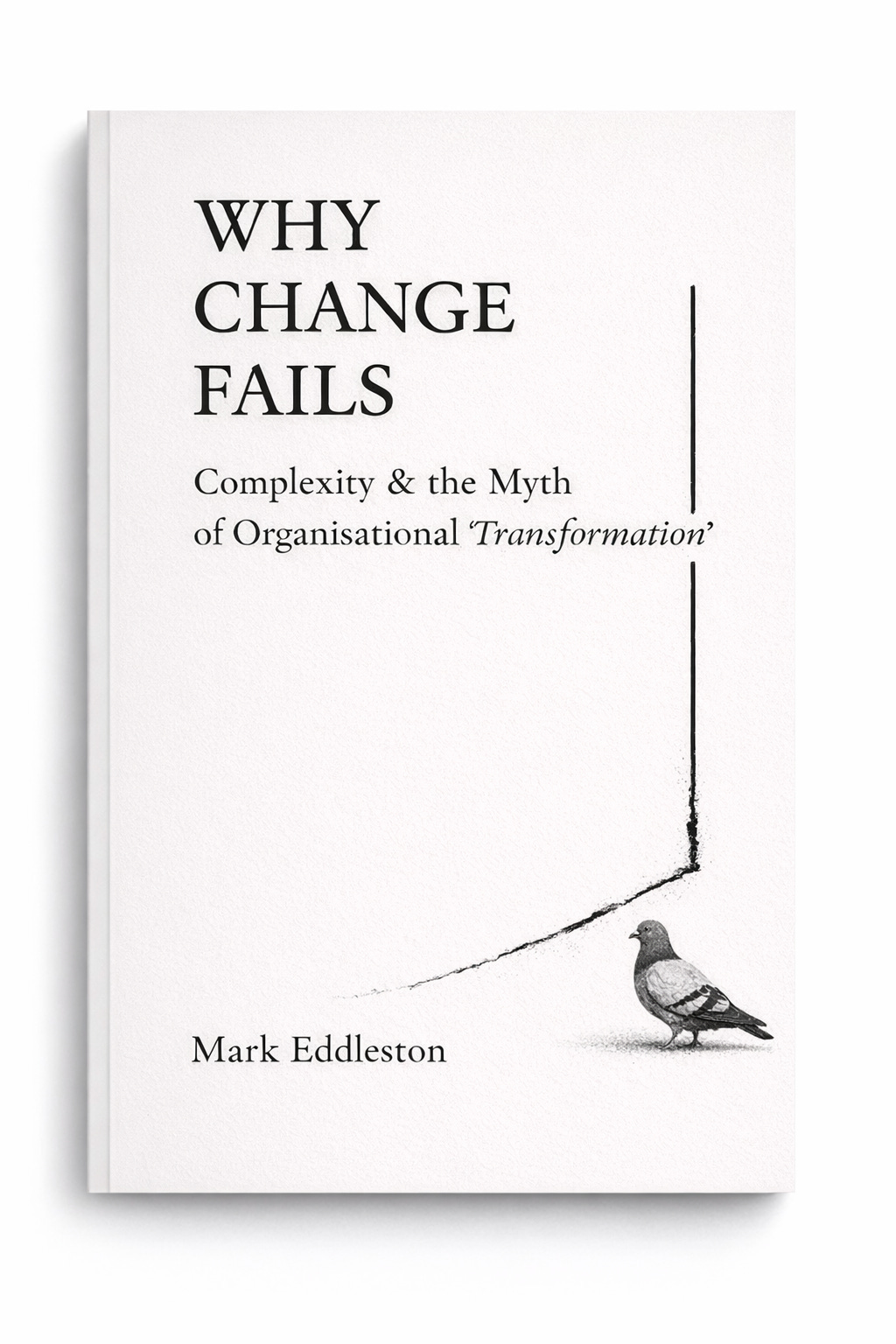
Since that post brought so many of you here (welcome 👋), I wanted to share the reflection that started the conversation, alongside a recap of the book I’m currently writing in public.
A dominant pattern across the New Ways of Working, self-management, and the wider change and transformation space is complexity references decorating linear thinking.
Patron saints Stacey, Snowden and Wheatley are routinely referenced in linear advice, then the next paragraph is a five-step framework. I did this more than once 😬
We borrow the vocabulary whilst holding tightly onto a linear mindset, because we want the credibility complexity confers without the discipline it requires. The discipline is accepting that in complex systems, conditions may be tended but outcomes cannot be engineered.
So we preach complexity and then reach for 'levers'. New practices, fresh frameworks, inner work, relational shifts. All dressed in complexity language but built with the same linear logic.
The adult development lever is particularly pernicious. Exactly the same trap as practices and frameworks, only it locates the problem in people rather than in the fundamental error of using linear recipes for a complex world. And it's near impossible to falsify. If the transformation worked, the leader was ready. If it didn't, they needed more work. There's always more work to do... It's a get out of jail free card.
The conversation is still going on over on LinkedIn, and I’d love to hear your take on 'Complexity Drag'. Let’s connect while you’re there!
Why Change Fails: Book Recap
All the attention led to an enormous spike in Substack subscribers, so with that and being around halfway through sharing the chapters of my book, I thought now would be a good time to re-share chapters one to five so you can catch up in case you missed any.
The moment the old ways of working stopped making sense.
Chapter 2: What I Was Selling When I Started Wobbling
A confession of the linear frameworks I used to believe in.
Chapter 3: The Evidence I Ignored
Why we filter out data that challenges our mental models.
Chapter 4: Linear Thinking’s Origin Story
Tracing the roots of our obsession with predictability.
Chapter 5: How it Infected Management Theory (now significantly updated)
How linear logic became the "operating system" of the office.
Chapter 6: Why Consultants Keep Selling BS
Coming next week…
Support the Newsletter
I’m halfway through sharing this book. If you’ve been getting value and you’d like to support me to continue, please consider upgrading to a paid subscriber 🙏
Many thanks, Mark, for sharing your book here and on LinkedIn. That’s very generous of you, and it’s certainly a message that’s needed.
In relation to your post, Linear Mindsets in Complexity Drag, below is an excerpt from my book VANTAGE POINT that aligns with what you’re pointing to.
_
Shifting from a hierarchical to a self-organising mindset and structure is certainly no easy feat.
We have spent centuries perfecting the art of mechanical thinking and have ingrained this thinking into our organisational and institutional fabric. It has become embedded in the psyche of many of our communities and social structures. It is anchored in our neurology and has become habitual.
Given this, it seems to me that many organisations that have tried to shift or take on some of the aspects of self-organising principles have done so with limited or no success.
“All change is hard at first, messy in the middle, and so beautiful at the end!” Robin Sharma
The reason for this is, that they either have approached this process with a mechanistic mindset and methods and tried to control it … which cannot be controlled. Or they haven’t given it sufficient time to make it stick and have been drawn back into their old default setting.
The mechanic wants to force change, to set timelines and prescribed outcomes. The self-organiser understands that self-organisation is a natural process of emergence that cannot be forced.
“Shifting your culture from a forced mechanically driven paradigm to its innate self-organising nature is like releasing a captive animal back into the wild … it’s a gentle process best facilitated with lots of patience, kindness, and care!” Mike Schwarzer